


The Mageska Fund
In 2025, the Mageska Fund delivered a net performance, after fees, of 9.72% for Series F and 10.36% for Series J, compared to a return of 10.07% for its benchmark. Series J thus outperformed its benchmark over a full calendar year — a first for the Mageska Fund since its inception in 2023.
Since June 1, the Fund’s performance has been solid, outperforming its benchmark in all but one month. The implementation of our modern and dynamic portfolio architecture coincided with this period of outperformance. We will elaborate further on this portfolio construction later in this letter.
A U.S. Economy That Remains Robust
A defining characteristic of 2025 was the resilience of the U.S. economy. Economic growth exceeded economists’ expectations on multiple occasions, and this resilience persisted despite significant headwinds, including trade-related uncertainty, tariffs, immigration restrictions, and rising geopolitical tensions. At the same time, several supportive factors gained momentum. Artificial intelligence and the rapid expansion of data centers continue to drive investment, while the U.S. dollar weakened against most major global currencies.
In summary, despite notable volatility — including a market correction of approximately 20% in April — 2025 marked a third consecutive year of equity market gains. Moreover, current conditions provide a constructive backdrop for 2026. The Federal Reserve is expected to adopt its most accommodative stance since 2022, with interest rate cuts now increasingly plausible over the year ahead. With the fight against inflation nearing completion and the labor market showing signs of softening (see chart on the left), the path is opening for this adjustment in monetary policy.
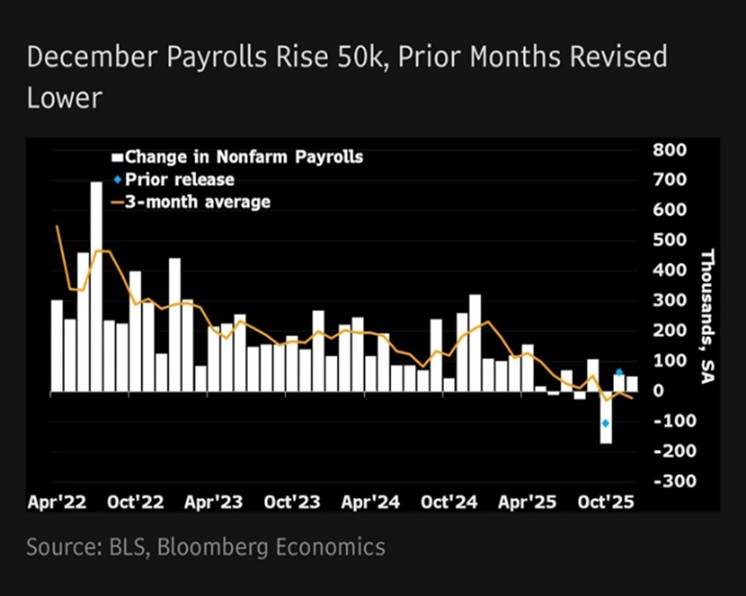
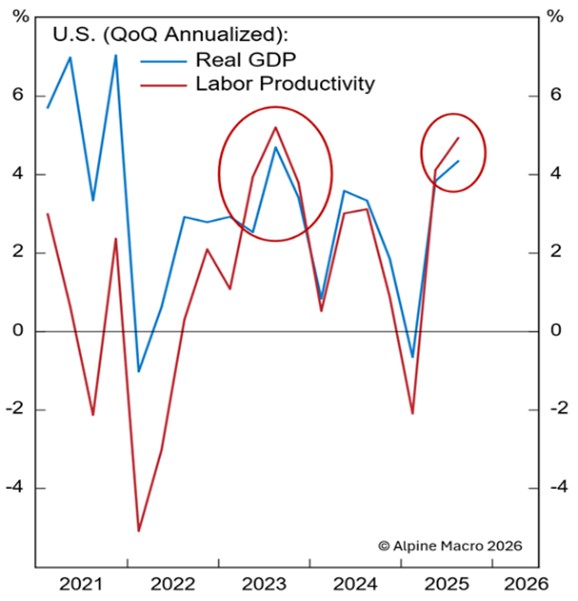
In addition, corporate earnings growth is expected to continue, supported in part by the broader adoption of artificial intelligence.
Productivity gains are inherently disinflationary. Artificial intelligence is fundamentally an optimization technology: it enables companies to produce the same — or even greater — output with fewer human resources. In an AI-driven growth environment, overall supply therefore tends to expand structurally faster than demand, creating a persistent disinflationary bias. The combination of declining interest rates and meaningful productivity gains (see chart on the right) provides a supportive environment for the continued upward trajectory of equity markets.
A Modern Architecture for the Mageska Fund
The Mageska Fund seeks to deliver sustainable outperformance by combining sources of return that are weakly correlated with its benchmark. This approach, widely adopted by institutional investors, aims to improve the portfolio’s risk/return profile and enhance the consistency of results over time. In an environment marked by increasing market concentration and the growing dominance of passive strategies, it provides a structured way to pursue active outperformance.
The year 2025 allowed us to further refine both our approach and the execution of this architecture.
In January, we added the GMV (Global Minimum Volatility) strategy, managed by Nymbus Capital, as an overlay. This systematic strategy, updated on a weekly basis and implemented through futures contracts, seeks to deliver positive returns on a year-over-year basis. Since inception, only one year has resulted in a negative return, namely 2015.
In June, we subsequently integrated the Low Correlation strategy managed by Mageska, which also targets positive annual returns.
These overlay strategies — or “return stacking” strategies — are invested across asset classes and categories that are uncorrelated or weakly correlated with global equities and bonds. In practical terms, they tend to respond differently to economic cycles and market shocks, helping to balance the portfolio across a wide range of market environments.
The chart below, produced by Fidelity Investments, illustrates this approach. The yellow envelope highlights the assets that have historically offered the most favorable risk-adjusted returns relative to a traditional 60/40 portfolio. These include gold, the U.S. dollar, Treasury bills, China, private loans, managed futures strategies (market neutral), and macro hedge funds.
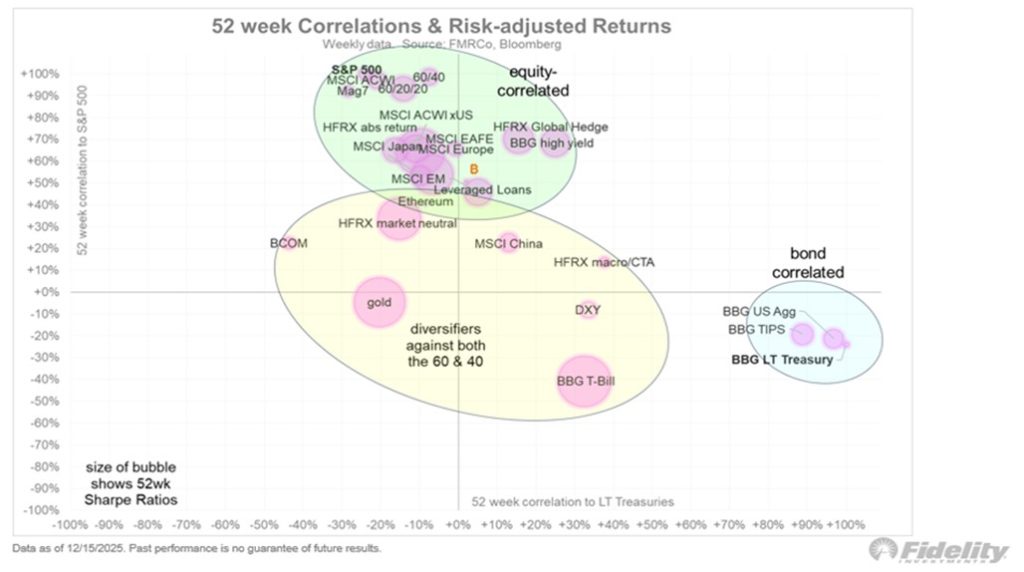
The combination of exchange-traded funds (ETFs) and futures contracts within the Mageska Fund allows us to integrate these complementary sources of return and to create the conditions necessary to pursue long-term outperformance relative to our benchmark. It is worth noting that more than 80% of active managers underperform their benchmark over 3, 5, and 10-year horizons. In this context, genuine diversification of return sources becomes an essential component of long-term value creation.
The Importance of Holding Real Assets in the Current Environment
Fiscal and monetary imprudence by governments may, over the long term, lead to a depreciation of fiat currencies. Recent price movements in gold, silver, and copper, to name just a few, clearly illustrate this risk.
This is compounded by repeated attacks from the U.S. Administration against the Federal Reserve, as well as the prospect of the forthcoming appointment of Jerome Powell’s successor, developments that could undermine the very principle of central bank independence, a cornerstone of global financial stability. Should monetary policy become a political instrument, the rules of the game would change for everyone, from Wall Street to Main Street.
In such an environment, holding real assets represents a tangible way to protect portfolios and preserve purchasing power. The Mageska Fund is designed to provide this type of exposure. Throughout 2025, the Fund maintained an allocation to commodities through ETFs linked to gold and silver, as well as through the use of gold futures contracts.
This structural flexibility contributes to improving the portfolio’s risk/return profile while offering enhanced protection against monetary erosion.
A Major Rotation in 2026?
Since late 2025, we have observed potential early signs of a rotation toward sectors beyond technology. The charts below illustrate, on the one hand, the relative performance of mid-cap equities compared to the S&P 500, and on the other, the relative performance of European, Asian, and Middle Eastern markets (MSCI EAFE), also measured against the S&P 500.
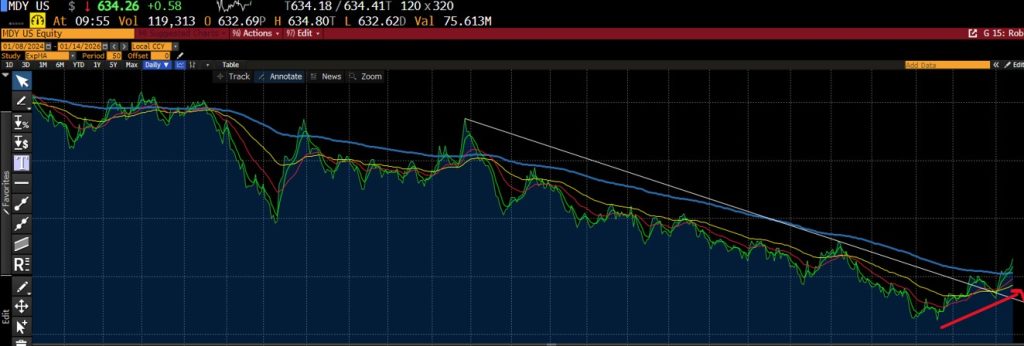
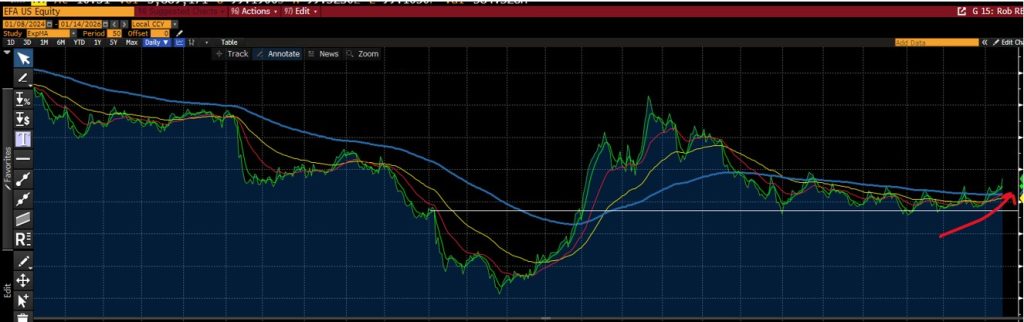
Dans les deux cas, la tendance semble amorcer un point d’inflexion.
The Mageska EcoVision Fund is Launched
In October 2025, we launched the Mageska EcoVision Fund, a global equity fund that enables investors to allocate a portion of their portfolios to companies positioned to benefit from the transition toward a low-carbon economy.
EcoVision is a thematic strategy built around three core pillars:
- Energy transition
- Circular economy
- Preservation of natural capital
These themes reflect deep, long-term transformations in the global economy. Significant capital is already being deployed across these sectors, regardless of policy rhetoric sometimes observed south of the border. The data speak for themselves: these structural forces are shaping tomorrow’s economy.
Demand for this type of strategy continues to grow steadily among institutional investors, private foundations, and high-net-worth individuals. It is often driven by the next generation of investors, who are increasingly seeking portfolios that align with these broad economic and environmental transitions.
A Major Institutional Recognition
The selection of the Mageska EcoVision Fund strategy by the Québec Emerging Managers Program (PGEQ), as part of a $50 million institutional mandate, underscores its relevance and robustness.
This recognition represents a significant milestone for Mageska. It validates not only the strength of the EcoVision strategy, but also the rigor of our investment process, the solidity of our operational structure, and the quality of the Mageska team.
We invite you to consult the Mageska EcoVision Fund presentation to learn more about its foundations, structure, and long-term vision.
We sincerely thank you for your trust and look forward to continuing this journey together in 2026.
Roberto Marrocco, CFA
Chief of investments and operations